Ritviz
by Mister Mime
18th November 2021
One Sunday evening, a couple of days after Diwali, I was walking through the National park in Mumbai - my little escape from the big city. It was close to sunset and nature’s orchestra was just warming up to take over the sonic scape of the night. On this day, I had been in a rather brooding mood, which is particularly rare in my case…one of the few times when life had got the better of me. I was subconsciously searching for a sign that life is beautiful - as if I really needed one - a silver lining.
Then as if out of a movie scene, a kid on a bicycle with her phone in her back pocket drove past me, and from her phone speaker, ‘Pran’ by Ritviz was playing at a rather modest volume. She had an innocent and joyful abandon about her as she clumsily rode her bicycle while bobbing her head to the beat. At that moment, it appeared to me like she, I, the bicycle, the park, and indeed all of Mumbai was dancing to the same tune. We were one with the music and in harmony with nature.
About fifteen mins later, I saw a group of kids sitting in a circle on the rocks, enjoying the sunset with just one phone speaker and another Ritviz track that very evidently was leading them into an almost inebriated state of bliss. But this wasn't the effect of Old Monk, Bacardi or Kingfisher...it was just the music. Because it understands you. And when you understand that, then life is never the same.
So who is Ritviz, the man behind the music? A young man just hopelessly in love with life..? Read on and find out!
MM: When I hear your music, I hear a young man hopelessly in love with life. So, who is Ritviz?
Ritviz: Haha yeah that's one way to put it. That's a very interesting observation. I suppose that's one way to interpret it. The one major thing that I have noticed in the last 5 years is that my music has been received in a lot of different ways, completely different from how I have tried to produce it, and from what intentions I had while making it. The pure thought here is that while making what I did, it wasn't so much thought out as it was felt. All the stuff that I make today is basically a reflection of my everyday life. So, what you mentioned is one interpretation of it. I keep receiving a lot of aspirational feelings from my music, and that's also one of the key things that people feel while listening to my music. So, it's a very interesting topic because when I make music, I don't think about what I'm doing. It's basically about what emotions I'm going through at the time. Of course, there's always a post-analysis, which is what we're doing right now in this discussion. So, I write a song, and then I think about 'why' I did it.
MM: You talk a lot about love, rejection, and all the other associated things in a very light vein. There is a playfulness, a carefree-ness, and even an element of mischief in your music. In fact, what I was thinking today while listening to your tracks was that if Lord Krishna was present as a person in this day and age, he would be jamming out to your tunes! Playful, flirtatious, joyful and mischievous are some of the main qualities that we associate with him.
Ritviz: Hahaha that's crazy!
MM: The brain goes where it wants to go, and connects some weird dots in there haha. Anyway, let's get to the album. Can you tell us about your relationship with Nucleya? And also how the album was conceived?
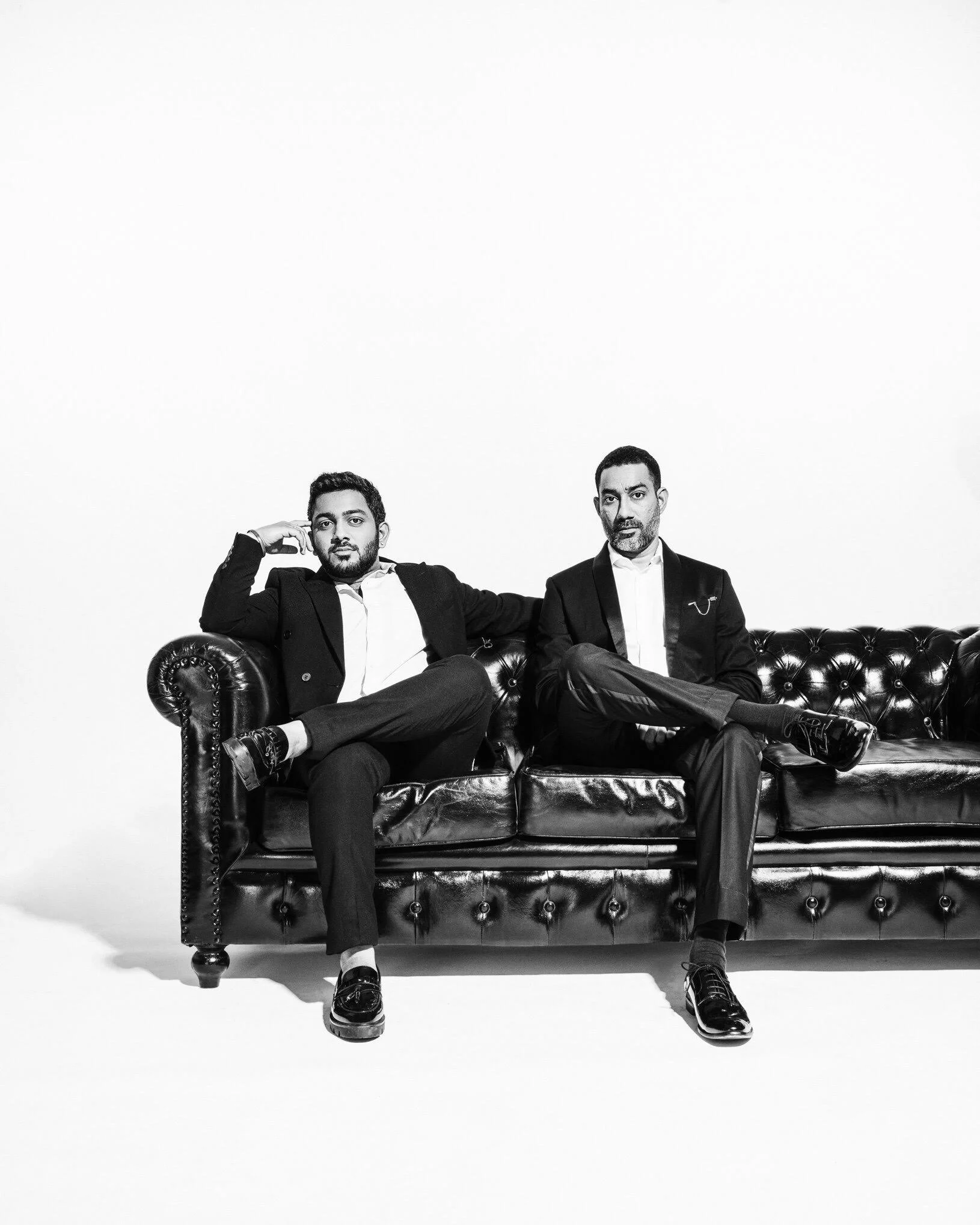
Ritviz: Udyan and I go way back. It was around 2015 when I first met him, Rather when he saw me perform live at NH7 Delhi. I was playing the 4 pm slot, and there were only 3 people in the crowd, my parents and Udyan. I was introduced to him at the festival, and he dug my music. We've known each other since then. This was of course the first peak of Nucleya when every household was talking about him. Everyone was talking about ‘Bass Rani’ and ‘Koocha Monster’, and I was one of those kids as well.
He is a mentor to me, and over the last 4 years, we've become friends. So it's a ‘bada bhai’ (big brother), friend, mentor kind of relationship. I can't really classify it. For me, it's been a journey of constant learning with him, because that's the kind of person he is. He has made me learn the want to learn. When I started off, I was drawn to him because of his personal life. He has one of the most beautiful families I've seen: a kid and a wife and it's amazing to watch him grow with them. And that's what I found awe-inspiring about him. It wasn't really the music, because I believe that the music is just a by-product of that. When I saw him being the father and the husband that he was and is, it really made me aspire to have these certain things in my life one day, you know. And the last 4 years have been like that for me. Over the years I've lived with him for a bit and watched him (develop). The thing with us, which I have with a very few people, like Seedhe Maut, is that every time we meet, we end up making music. Every conversation turns into a song. So, it's such an effortless music-making process that after a good 4 years, Udyan and I realized that this would be the year that we put out our music because we have a ton of songs in the bank. So, to sum it up, this has been more or less my relationship with him.
MM: That's a very interesting point that you mentioned. Because usually when people look at such an artist like many people would be looking at you that way, for example, they see the more 'obvious' things like the music itself of course or the fame, and hits they produce for instance. But when you looked at him, it was the life that he created for himself that intrigued and inspired you. I wish this kind of perspective was spoken about more. I believe we would be able to produce so many more great artists, producers, musicians and people.
Ritviz: Absolutely. I think that people are too influenced by the peripherals that come along with the music, or any kind of content that you produce. And the problem with that is, if the focus is on the by-products or all the things that your art will get you, then it wasn't about the art in the first place. If you took that away from me, I would be hollow. I couldn't be more grateful to be where I am today because of the people who cared to listen to my music.
One of the things that I started doing about two years ago, was that I started to separate my personal from my professional life. Let me tell you why. Say I'm going through a creative block, I completely forget who I am without my music. And this is a very integral part of who I am today. Four years ago I faced a very massive block, which made me question a lot of things about myself. This was after 'Udd Gaye' came out. I had gigs lined up, but I was going through a massive block. Now that I look back on it, it was very important for me because that's when I realised that I needed to separate my music from me. Until that point, my identity was music. And why I'm talking about this is because it's a boon and a bane. If you took the music away from me, I wouldn't know what I would be. So that's what I started to build on. I felt like my professional life reached some height while my personal self was still a baby. And I'm still building my personal self, for the sole reason that the music-making process is the biggest thing in my life. I can’t say that I will be able to ever change that position, but I'm trying to support it with other things in my life. So I don't go completely hollow when I'm not able to make music. Everything that comes with music is just peripherals that are good supporting acts. The main act is always going to be about the music and why I do what I do.
MM: Yes I see. So that if you took away all the fame, admiration, likes, etc, you're still more or less complete as a person. Let's get into the album a bit more. Do you have any stories to share behind the making of the 4 songs that you've released so far?
Ritviz: Every song has a fun story, and stems from and is surrounded by a conversation. Udyan and I live about 20 minutes apart in Goa so frequent visits keep happening.
For most of the songs, I remember sitting in Udyans studio... For example, 'Roz' was a fun track that started off as a joke, quite literally. The way we do it, it's so effortless that there's really no formulated way of making music. There's just constant having fun and talking, making sure that we're having a good time, and the next thing you know, you have a 3-minute song structure in place. 'Saathi' came about that way. We were very nostalgic with the album, going back to the 90s, discussing older music, and about how we grew up, and all of this resulted in the final product.
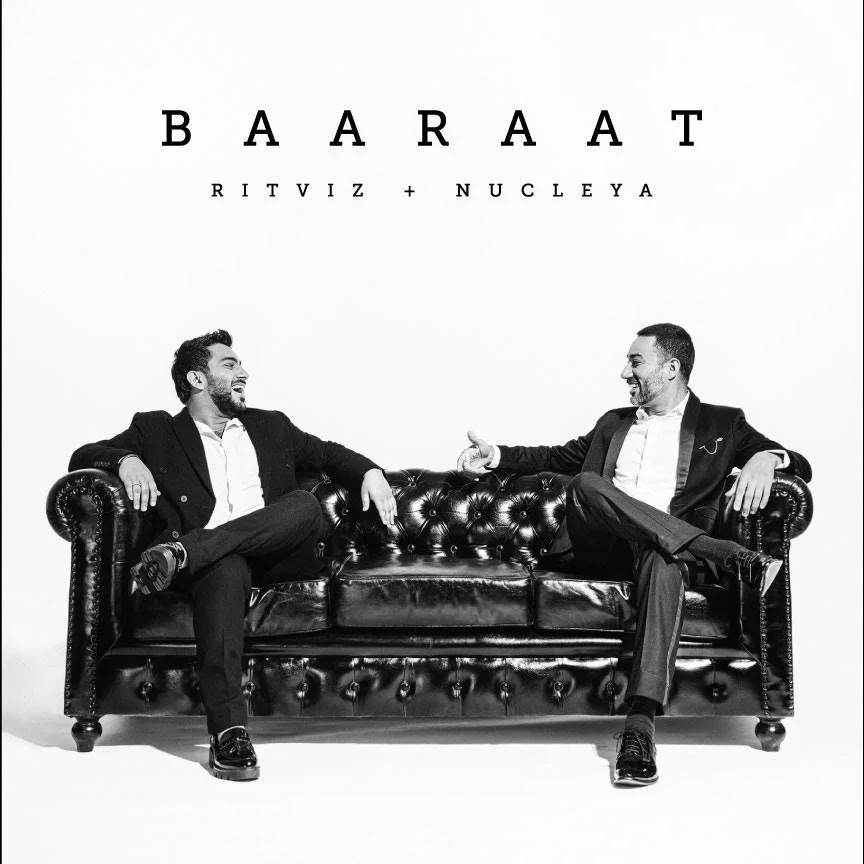
MM: What about the theme of 'Baaraat'? Does it have something to do with weddings?
Ritviz: No, not at all. It's basically the marriage between Udyan's sound and mine. That's the key right there.
MM: I believe that you are changing the face of Indian music. Did it happen consciously from the start? Did you have a desire to impact our music scene in a certain way?
Ritviz: Well, yes and no. When I was in my teens, I looked at not only the Indian scene but rather, all of the music that we were consuming back then, around 2007-2008: the VH1 Top 40, the stuff that all of us were listening to, when we were obsessed with bands like Linkin Park. At the time, I remember feeling the need to bring something to the table. I felt that at a very young age, and that was something that probably stayed in my subconscious, but there was no consciously planned effort to do something like this. There was a void that I felt I could fill, something I had to offer. And then it became about producing the music that I really liked. Now, looking back at what I've done over a 10 year period of music-making, I realized that even when I was pulled towards electronic music and the few genres that I was obsessed with in my formative years, I wasn't really able to replicate it even if I wanted to. I would get mad at myself for not being able to produce a house track and follow rules, which is one thing that I'm extremely bad at. In hindsight, I see how that worked in my favour because it helped me establish my sound. So it started off with me being very poor at following rules and not being able to be someone else, without even realising that subconsciously I was trying to build something else. When I look back, this is what I see.
And in ten years of being influenced by Indian Classical music, Western Hip-Hop, Top 40 hits, just about anything and everything. Even the stuff I didn't particularly like. Influences are of all kinds. And today, it has become about the fact that this is where I'm at right now, and I only want to continue on this journey. I feel like it's barely the beginning. I'm still on my stepping stones. It gets extremely hard sometimes as it did for me a few years ago. This is all new to me too right?! When you suddenly have an audience and you have people who start expecting something from you, it's very hard to look away and keep doing your thing.
MM: It's like your favourite nightmare kind of situation…
Ritviz: Yeah. So, the agenda for me is to continue being the person I was back in 7th grade. That's my constant reminder, that I can always do something that can try to please the audience in a way that I've already done in the past. But say, if I do something today that might not adhere to my current audience, it can actually bring me another audience tomorrow. So, in the hopes of that, I will continue to evolve and do things that might or might not come across a certain way and that's something that I can't help. Those are the consequences of actions that I have to take because that will help me reach from point A to point B. It's a constant journey and I hope it keeps going forward.
MM: How would you describe your sound? Hindustani EDM? Modern ‘Digital’ ghazals? Let's talk about your influences. I feel that will help to reveal how your sound formed. Can you tell us about your musical upbringing and journey? I know that your parents were very influential in that.
Ritviz: Yes very much! For me, my mom is my biggest influence in terms of an everyday source of energy. I look up to her, and it's always been like this: my mom being around me and nodding her head which gives me validation. She is a thousand times more creative than I am, and will ever be. Whatever I do today is only because I've watched her do her thing while I was growing up. She is such a real-life role model who has always been with me.
My mother is an Indian classical singer. She is the HOD (Head of Department) of Performing Arts at DPS (Delhi Public School). My dad plays the tabla, and professionally he is a banker. Mom still caters to the music side of things, so I've always had music at home.
I heard my first Tiesto bootleg in 2012. That was the first thing that drew me towards learning about electronic music. This was around the time that I was going to drop out of school, and I originally started out as a vocalist. I learned Indian Classical gayaki, so I had some education on the vocal side of things. Production, however, was an area about which I had no idea, and hence it was a very interesting thing for me. Right around the time when I started learning about electronic music, I was also badly in need of complete creative control over my music. Obviously, that would only happen if I learned to produce tracks for myself. So, if I am simply sitting down and an idea hits me, I can build it from scratch and bring it to completion. That gives me the biggest sense of power and satisfaction. So, that's what I was in pursuit of back in 2011-2012, and that's how I got into production.
I remember Youtube being the guru, and it still is an invaluable tool to self-learn. I dove deep into production with it, and if you listen to my initial work, it's mostly instrumental. There were hardly any vocals. Now, it has reached a point where it's become a balanced mix. The funny thing is that the first one or two tracks that I made were a good mix of my vocals and instrumental expression. Then, I completely went into an electronic instrumental zone for a while. And with 'Udd Gaye', I came back to find a balance between the two, as it remains today.
I look at my vocals too as an instrument. Every layer of the song is another instrument, and I'm like a conductor
MM: When did you become comfortable with finding a place for your vocals in your music? Was there a learning curve involved that led you to become assured about singing on your own tracks?
Ritviz: A lot of people think that I started using my vocals only later in my music, but the truth is that I started off with my vocals and production came in later. I think I needed to establish myself as a producer before I could match it with the vocals that I brought to the table. I only added my vocals when I felt the need to do so. It took me a couple of years to polish my sound as a producer and the vocals had to match.
I look at my vocals as the purest way of expressing a thought or a feeling. If I go to a singer, it would be different. It's a process to be in sync with someone enough that they could express what you feel in the same way, no matter how skilled the singer may be. It's like I felt certain things, and I'm expecting somebody else to express it for me.
Of course, now, I'm not so much of a purist. I believe that it’s absolutely possible to collaborate and express yourself well, which is what's happening with Udyan and Seedhe Maut. But when I started off, I was very rigid about doing everything on my own.
MM: Your take on music, the mix between Hindustani Classical, EDM, and everything else that constitutes your sound is very unique. Broadly it could be called EDM or whatnot, but there is a very specific and personal sound that you have. If you got a traditional Classical vocalist to sing on your track, it just wouldn't be the same. It probably wouldn't be as carefree and playful.
Ritviz: Absolutely, it's not only about the skill. It's about how well you're able to express the emotions inside of you. For me, that is the most important part of a song. The whole point of art is to move you. I don't know what it is in our minds that leads us to be caught up in genres, rules and things like that but The minute we try to 'understand' it or break it apart, we are missing the point. Especially in the entertainment world, you should not come in with a lens
MM: Can you tell us about your vibe with Seedhe Maut? How do you guys make the music happen?
Ritviz: It's similar to the vibe with Udyan. It's a very effortless thing. I'm still a fanboy, to be honest, and I was the one who reached out to them first. I remember going to their place in Delhi and we ended up writing two songs. Even the boys come from a place that if we are in sync, the music will come as a by-product. The music that they put out might be on the serious side, but they are much more than that. On the next album, there will be a new side to Seedhe Maut that will come out, and a new side to me too since all three of us stepped out of our comfort zone.
In 'Baaraat' as well, Udyan and I tried to switch up our roles sometimes, and that's what makes it exciting and fun to collaborate. It's all about the flow. I feel like I don't write as much music as compared to these guys. Being around them, the quantity of music that I write has built up. Usually, I would put out 2-3 songs a year. This year, I set an extremely high goal of 21 songs.
MM: Can you name the most influential artist for you?
Ritviz: AR Rahman is a very important musician for me. I've always been curious as to how he forms his melodies. He is absolutely a masterclass and a case study. I get asked often about who I would love to collaborate with. I always say that if I even get to be in a room with him and watch him work, that would be epic!
My mom used to listen to 'Chhoti si Aasha' when I was a kid, so I have a lot of childhood memories associated with his music
From the West, I love Timbaland. He is a huge influence on me. I think they would make lovely music together!
MM: What are your interests outside of music?
Ritviz: I love food and cooking! It's my favourite thing to do apart from music. I've always been fond of cooking and I would normally just watch my mom cook complex dishes effortlessly. Our cuisine is quite complex, right? My move to Goa has also inspired me to cook often.
I was drawing parallels the other day between music and food. It's fascinating right?! So I had called my mom for her mutton curry recipe the other day, and this was a big one to crack for me. I had taken my time to learn the recipe and I told my mom I was ready. It was a rite of passage time. The thing that fascinated me most while she was guiding me was when she told me "Yeh yeh sab andaaz se daalna". And that got me thinking about what was essentially the creative aspect of cooking! I realised that my mother had such massive experience with this that she has reached the point of "Haath set ho gaye". And I feel like that with music a little bit as of today, where I can tell myself, "Andaaz se hi-hats daalte hain idhar". It's so important to trust your instinct and it's all about expression at the end of the day.
Apart from that, I've hated sports most of my life, and that has always worked against me while growing up. I hate to exercise but I've been forced to do so now. Goa is helping in that regard. The quality of air, which is the quality of life is very good. I love making music here. Also, the people I surround myself with is a big deal to me.
MM: You mentioned dropping out of school. Were you already sure at that time about making music?
Ritviz: Yes, I dropped out in 11th grade. I was sure about music in 9th standard. I am extremely blessed with the folks that I have, and that they allowed me to drop out in the first place. Secondly, I don't think I was a fan of the system anyway, especially for creative people. The Indian education system is even counter-productive to academically inclined people in many ways. So for creative individuals, it's pretty much like jail.
MM: Once you make it, it's a school-dropout success story. But did you feel any doubt along the way about your path?
Ritviz: Of course. And I'll tell you what - When I look back, the only thing that was in my favour all along was my folks. Yes, I was working 16 hours a day and I bet there are a lot of kids in 9th grade who are probably working more than what I did. But I know that I was giving all my time to music since way before 9th grade even. And my folks saw that. They watched me work the way I did. But the bigger picture that they built was they really entailed that trust in me. I didn't have to prove anything to them or validate myself for them. That was the biggest thing that could have been given to me at the time. From a very early age, my parents and I had a very transparent way of communication. So this wasn't really news to them when I took upon my path. It was years of talking, discussing. and showing it.
I remember telling my mom when I was 19, "Ma, this isn't happening for another 10 years at least." And she said that as long as I'm staying with them, making music and doing my thing, that's all that matters. That itself was enough of a boost to know that now, I am completely doing this for me. And that absolutely gave me the courage to keep at it. A lot of the time, it's only about how long are you willing to keep at it. I got very lucky because I wasn't expecting it to happen this soon. I was prepared for a very long journey. When I look at making music today, it doesn't feel like hard work because I love doing it. It's the most exciting thing for me to do. 16 hours a day doesn't feel like 16 hours. But 16 hours would probably feel like it if I was studying trigonometry hahaha
MM: A big shoutout to Trigonometry.
Ritviz: So that was my whole deal with academics. After 10th standard, I told myself this was it, and when 11th grade came in, my folks and I took that decision together.
MM: Ab ek board exam ho gaya, doosra nahi hoga.
{Shoutout to Saurav}
MM: What advice would you have for artists/producers/musicians in the current scenario of art and entertainment who are working on their craft to a point of their satisfaction?
Ritviz: The entertainment world is a very vague world, where everyone sort of figures out their own path. If you want to be a doctor or an engineer in this country, everything is in your favour, checkpoint after checkpoint, and you've been told about the path you have to follow. Society is in your favour, and you've been told to follow the regime and you have to put in the work. In my case, I had a great advantage because I had the best people supporting me to do what I do. What I didn't have in my favour was how to go about this process. I had to figure out how to make music, play it to an audience, communicate with people in a professional sense. No one came to me with a textbook saying that to be a musician, I had to do these things. So it's up to you to figure out what and how to go about it. Everyone I've spoken to has had a unique story, just owing to the fact that there is no certain way of going about it.
In this regard, I want some kind of system in place to facilitate this process. I would love for the right people to be in charge, people who put the art first. I want people of a certain calibre to be in the central positions when it comes to music and art. So if at all the tables have turned for me, I only want it to be better for the people who are coming up now.
One suggestion that I would like to share is that it's all D.I.Y. That's the way to go since that's the way you're going to learn about yourself. If you learn about yourself, that's the best tool to have. You could go to many music schools and learn various things, but the learning is always going to take place. I think people often forget that education is just a tool. People put education on a pedestal. You will learn things on the way if you know what you want in return. If I have certain ideas in my head and I need to execute this, I will figure out a way to execute them. But if I spend all my time learning how to execute something but don't know what it is that I want to accomplish, then it's pointless. People get too caught up in just the learning process. I need to learn things that will make me unique rather than learning something that 100 other people already know to no end. By all means, spend time learning things, but also spend a good amount of time away from the textbooks and with yourself and your thoughts, looking inwards rather than outwards.
My foundation in production came about because I spent 6 weeks on Ableton to figure it out. I learnt so much about the software that some of the things I use even today as tips and tricks were just things I built up on my own by spending a lot of time with the software and having very little textbook knowledge about it.
I feel like we are all constantly trying to absorb the knowledge around us. Rather, let yourself absorb things subconsciously. If you're consuming content, then the conscious absorption is happening automatically anyway. You don't need to go out of your way to absorb everything with the goal of creating something, because then you're just recreating or copying. This is just my opinion on how I look at content. It's better to enjoy a song or a movie, get inspired and then put down something that is a culmination of your influences but happening organically and subconsciously.
My final suggestion would be that upcoming producers should spend enough time with themselves so that they can figure out who they are first, rather than the world around them.
MM: You said that you feel you're just getting started. What's your expectation from yourself and what can we expect from Ritviz in the future?
Ritviz: One thing I never did was walk into something I did with expectations. Had I set expectations of any sort, I feel like it would have limited me. It is still a big question mark for me as to what I'm going to do in the future. The way I function is very impromptu and impulsive. My creative process is literally a reflection of what I'm going through in my life. So what I'm doing as of today is trying to be the best 25-year old that I can be, the best son, the best boyfriend today in the hopes that one day I can become a good father. Things that all of us aspire to be...the very basic human things, in the hopes that the reflection will be the music. So that's all I care about, to be honest.
One very interesting thing is that when I was with my folks and making music back then, like 'Udd Gaye', the music that I wrote was about the life that I imagined. Looking at Udyan, my mom, and other people that I really cared about, sparked a desire to be in a position where I'm living my own life fully. And today, in whatever sense, I'm very grateful to be able to do that. Now, the music is not imaginative, it's a reflection of the life that I imagined 4 or 5 years ago. So this has been my journey so far and I feel like I'm only moving away from music in the sense that music is becoming a by-product of whatever else I'm doing.
MM: One Final Question - What's your real name?
Ritviz: It's Ritviz! It's not an alias haha The story behind this is, it was originally Ritvij with a 'J'. And my dad changed the J into Z. It's a word in Sanskrit that refers to the Pandit who throws the offering into the fire during rituals.
You Can Follow Ritviz on:
All Images Courtesy of Ritviz
